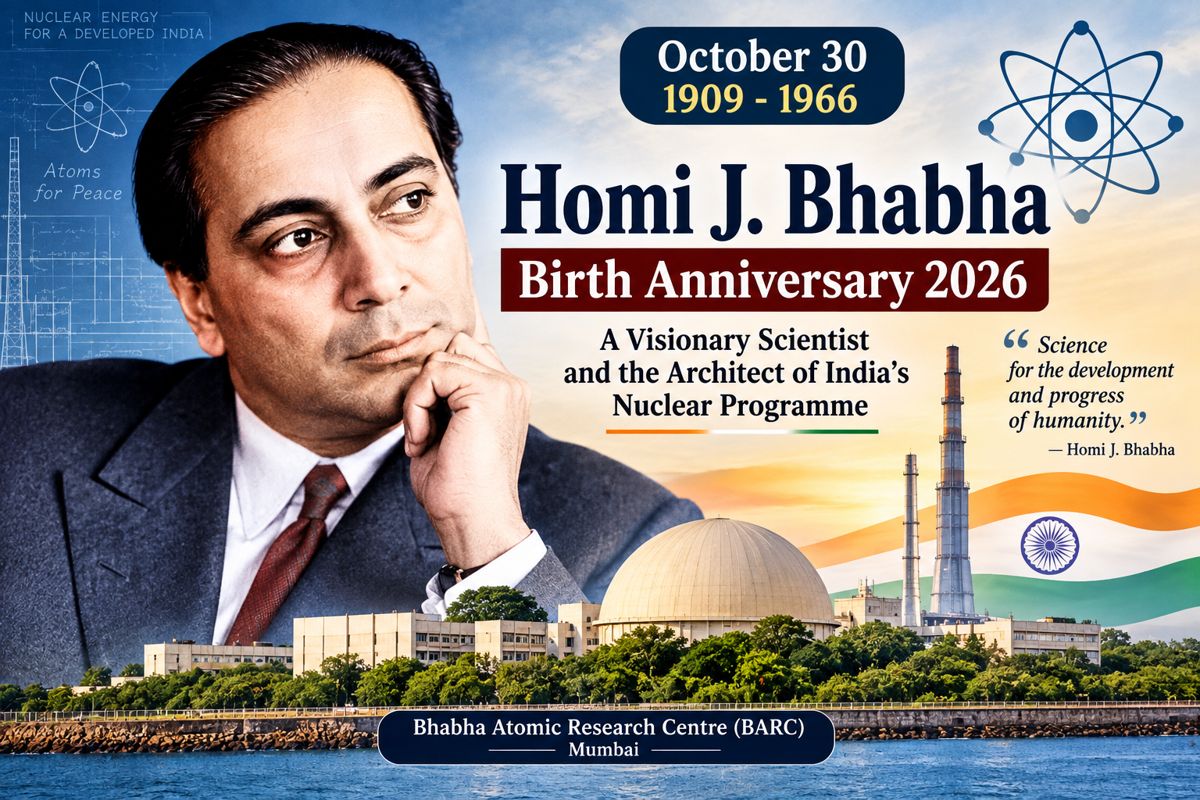
Homi J. Bhabha Birth Anniversary 2026 falls on Friday, October 30, 2026. The day marks the 117th birth anniversary of Dr. Homi Jehangir Bhabha, born on October 30, 1909, in Bombay (now Mumbai). He was a physicist, institution builder and a central architect of India’s atomic energy programme.
Homi Bhabha Birth Anniversary 2026: Quick Facts
| Date | October 30, 2026 |
| Day | Friday |
| Born | October 30, 1909 |
| Died | January 24, 1966 |
| 2026 observance | 117th birth anniversary |
| Known for | Physics, institution building and India’s atomic energy programme |
Who Was Dr. Homi J. Bhabha?
Dr. Homi Jehangir Bhabha was one of the most influential scientific institution builders in modern India. Official material from the Bhabha Atomic Research Centre records that he was born on October 30, 1909. After studying in India, he went to Cambridge, where his academic work moved from engineering toward theoretical physics.
Bhabha developed an international scientific reputation through research in cosmic rays and particle physics. After returning to India, he joined the Indian Institute of Science in Bengaluru and later played a decisive role in building institutions for fundamental and nuclear research.
Why Homi Bhabha Is Important to Indian Science
Bhabha believed that India needed strong domestic scientific institutions if it was to develop advanced science and technology independently. This conviction shaped his institution-building work. He founded the Tata Institute of Fundamental Research in Mumbai in 1945. When the Atomic Energy Commission was established in 1948, Bhabha became its chairman.
He later established the Atomic Energy Establishment, Trombay, in 1954. After his death, the establishment was renamed the Bhabha Atomic Research Centre in his honour. These institutions became major parts of India’s scientific research infrastructure.
Education and Early Scientific Career
Bhabha studied at institutions in Bombay before joining Gonville and Caius College at Cambridge in 1927. BARC’s historical chronology records that he completed the Mechanical Sciences Tripos and later the Mathematics Tripos. He earned his PhD in theoretical physics at Cambridge in 1935.
His early research addressed cosmic radiation and particle interactions. The Bhabha-Heitler work on cosmic-ray showers became an important contribution to high-energy physics. He was elected a Fellow of the Royal Society in 1941.
Return to India and IISc
Bhabha was in India when the Second World War began in 1939 and subsequently joined the Indian Institute of Science in Bengaluru. There he worked in theoretical physics and cosmic-ray research. His years at IISc were important in the development of his broader vision for India’s scientific future.
Founding of TIFR
In 1945, Bhabha founded the Tata Institute of Fundamental Research. The institute was conceived as a centre where high-quality research in fundamental science could flourish in India. TIFR subsequently became one of the country’s leading research institutions.
Building India’s Atomic Energy Programme
Bhabha’s role extended well beyond laboratory research. He helped develop the organisational framework for India’s atomic energy programme and served as the first chairman of the Atomic Energy Commission. In 1954, the Atomic Energy Establishment, Trombay, was created for multidisciplinary research connected with the programme.
BARC describes Bhabha as the prime architect of India’s atomic energy landscape. His approach emphasized scientific training, domestic expertise and long-term institution building. The training and research structures he helped establish continued to influence India’s scientific development after his death.
Scientist, Engineer, Artist and Institution Builder
Bhabha’s interests were broader than physics alone. Department of Atomic Energy material describes him as a scientist, engineer and artist with a deep interest in science, art and culture. This combination is often highlighted when discussing his ability to think about scientific institutions not simply as laboratories, but as places that could cultivate creativity and excellence.
Homi Bhabha Birth Anniversary 2026 Wishes
- Remembering Dr. Homi J. Bhabha on his 117th birth anniversary.
- Tributes to a pioneering scientist and institution builder on Homi Bhabha’s birth anniversary.
- May Homi Bhabha’s commitment to science inspire students to remain curious and ambitious.
- Remembering the visionary who helped build some of India’s most important scientific institutions.
- On October 30, celebrating the life and scientific legacy of Dr. Homi Jehangir Bhabha.
- Warm tributes on Homi Bhabha Birth Anniversary 2026.
- May young minds continue to explore science with curiosity, discipline and imagination.
- Remembering a remarkable chapter in the history of Indian science.
WhatsApp Status Lines
- Homi J. Bhabha Birth Anniversary | October 30
- Remembering a pioneer of Indian science.
- 117th Birth Anniversary of Dr. Homi J. Bhabha | 2026
- Science grows when curiosity meets institution building.
- Remembering Homi Bhabha: physicist, visionary and institution builder.
- October 30 | Celebrating a landmark figure in Indian science.
Instagram and Facebook Captions
Caption 1: Remembering Dr. Homi Jehangir Bhabha on his 117th birth anniversary. His scientific work and institution-building vision helped shape modern India’s research landscape.
Caption 2: October 30 marks the birth anniversary of Homi J. Bhabha, physicist and architect of India’s atomic energy programme. A day to celebrate scientific curiosity and long-term vision.
Caption 3: From fundamental physics to building national research institutions, Homi Bhabha’s story continues to inspire students of science.
Short Speech for Students
Good morning everyone. Today we remember Dr. Homi Jehangir Bhabha on his birth anniversary. Born on October 30, 1909, he became an internationally respected physicist and one of India’s most important scientific institution builders. He founded the Tata Institute of Fundamental Research and played a central role in creating India’s atomic energy programme. His career reminds us that scientific progress depends not only on individual discoveries but also on laboratories, universities, training and opportunities for future researchers. On his birth anniversary, let us celebrate curiosity, evidence, creativity and the determination to build knowledge for society. Thank you.
Ideas for Schools and Colleges
- Organise a quiz on famous Indian scientists.
- Create a timeline of Bhabha’s life and scientific career.
- Conduct a presentation on cosmic rays and particle physics.
- Prepare a project about TIFR and BARC.
- Discuss why scientific institutions matter for national development.
- Hold a poster competition on Indian science pioneers.
- Ask students to research one major Indian scientific institution and present its work.
Frequently Asked Questions
When is Homi Bhabha Birth Anniversary 2026?
It is observed on Friday, October 30, 2026.
When was Homi J. Bhabha born?
He was born on October 30, 1909, in Bombay, now Mumbai.
Which birth anniversary is in 2026?
October 30, 2026 marks his 117th birth anniversary.
What did Homi Bhabha found?
He founded the Tata Institute of Fundamental Research in 1945 and established the Atomic Energy Establishment, Trombay, in 1954.
Why is BARC named after Homi Bhabha?
After Bhabha’s death in 1966, the Atomic Energy Establishment, Trombay, which he had established, was renamed the Bhabha Atomic Research Centre in his honour.
What was Homi Bhabha’s field?
He was a physicist whose research included cosmic rays and particle physics, and he later became a major scientific institution builder.
Explore More October 2026 Articles
Explore more important dates and personalities in CareerSphere News. You can also read our APJ Abdul Kalam Birth Anniversary 2026 coverage.
Final Note
Homi J. Bhabha Birth Anniversary 2026 is an opportunity to introduce students to a scientist whose influence came from both research and institution building. His life connects fundamental physics, scientific education, national research infrastructure and the long-term development of India’s atomic energy programme.
Leave a Reply