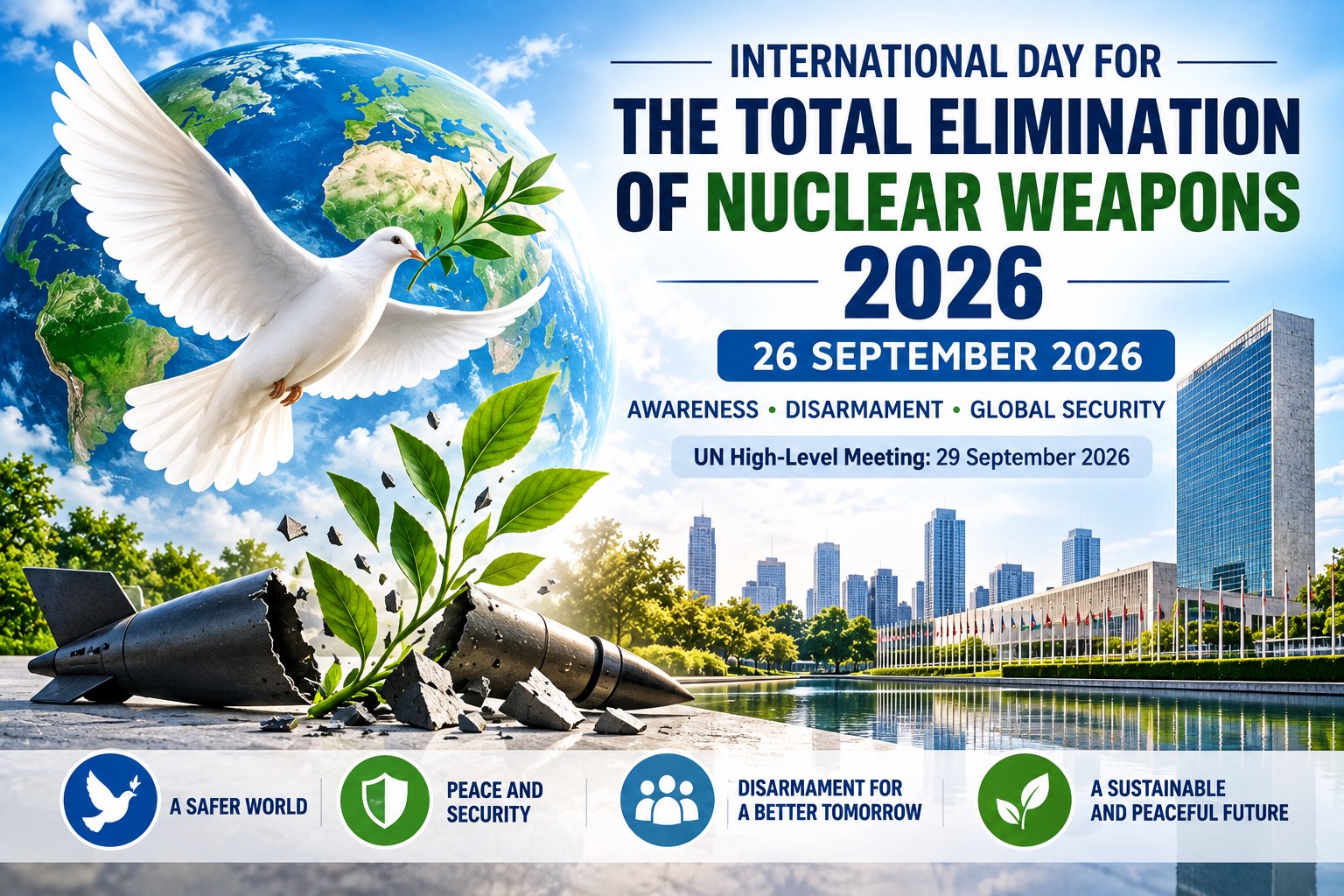
International Day for the Total Elimination of Nuclear Weapons 2026 is observed on 26 September 2026. Established by the United Nations General Assembly, the day is intended to raise public awareness about the threat posed by nuclear weapons and to promote the long-term objective of global nuclear disarmament.
International Day for the Total Elimination of Nuclear Weapons 2026: Overview
| Date | 26 September 2026 |
| Day | Saturday |
| Established by | United Nations General Assembly |
| First observed | 2014 |
| Main purpose | Awareness and education about nuclear disarmament |
What Is the International Day for the Total Elimination of Nuclear Weapons?
The United Nations General Assembly declared 26 September as the International Day for the Total Elimination of Nuclear Weapons through resolution 68/32. The observance provides an opportunity for governments, international organizations and civil society to discuss nuclear disarmament and educate the public about the humanitarian and security consequences associated with nuclear weapons.
Why Is September 26 Observed?
The date is connected with the UN General Assembly’s 2013 high-level meeting on nuclear disarmament. The international day was subsequently established to maintain attention on the objective of eliminating nuclear weapons and to encourage continued international engagement.
Why the Day Matters in 2026
The UN describes nuclear disarmament as its highest disarmament priority. The issue remains particularly significant in 2026 because the New START treaty between the United States and Russian Federation expired on 5 February 2026 without a successor arrangement, according to the United Nations.
The UN also held the Eleventh Review Conference of the Parties to the Treaty on the Non-Proliferation of Nuclear Weapons from 27 April to 22 May 2026. These developments form part of the wider international debate about arms control, non-proliferation and disarmament.
2026 UN High-Level Meeting
Because 26 September falls on a Saturday in 2026, the UN General Assembly’s high-level plenary meeting commemorating the international day is scheduled for Tuesday, 29 September 2026 at United Nations Headquarters in New York. The meeting is intended to promote public awareness and international efforts toward nuclear disarmament.
What Is Nuclear Disarmament?
Nuclear disarmament generally refers to reducing and ultimately eliminating nuclear weapons. It is related to, but distinct from, nuclear non-proliferation, which focuses on preventing the spread of nuclear weapons to additional actors. International agreements, verification arrangements, diplomacy and confidence-building measures have all played roles in efforts to manage nuclear risks.
The Role of the United Nations
Nuclear disarmament has been on the UN agenda since its earliest years. The General Assembly’s first resolution in 1946 created the Atomic Energy Commission and addressed proposals concerning atomic energy and weapons adaptable to mass destruction. Since then, nuclear arms control and disarmament have remained recurring subjects of international diplomacy.
Major International Frameworks
International nuclear governance includes the Treaty on the Non-Proliferation of Nuclear Weapons (NPT), nuclear-weapon-free-zone treaties and the Treaty on the Prohibition of Nuclear Weapons (TPNW), among other arrangements. Countries differ in their participation in, and approaches to, these frameworks, but the UN observance focuses on the stated objective of a nuclear-weapon-free world.
India and Nuclear Disarmament
India has historically participated in international discussions on nuclear disarmament while maintaining its own nuclear doctrine and security policies. Debates around nuclear policy involve national security, deterrence, international law, verification, arms control and humanitarian concerns. Readers should distinguish between the UN’s disarmament advocacy and the different security positions taken by individual states.
How Schools and Colleges Can Observe the Day
- Conduct a seminar on the history of nuclear disarmament diplomacy.
- Organize a model United Nations discussion on arms control.
- Prepare timelines of major nuclear treaties and international initiatives.
- Hold an essay competition on peace, security and disarmament.
- Use official UN resources to discuss humanitarian and security concerns.
Awareness Messages for 2026
1. September 26 is a day to learn about nuclear risks, diplomacy and the international effort toward disarmament.
2. Dialogue, verification and international cooperation remain central to efforts to reduce nuclear dangers.
3. Building public understanding is an important part of the global conversation about nuclear weapons and security.
4. A safer future requires informed discussion, diplomacy and sustained international engagement.
Quotes and Social Media Captions
“Peace and security require both responsible policy and sustained dialogue.”
“Reducing nuclear risks is a challenge that crosses borders and generations.”
26 September 2026 — International Day for the Total Elimination of Nuclear Weapons. Learn about disarmament, diplomacy and global security.
Frequently Asked Questions
When is the International Day for the Total Elimination of Nuclear Weapons 2026?
It is observed on Saturday, 26 September 2026.
Who established the international day?
The United Nations General Assembly established it through resolution 68/32 in 2013.
When was it first observed?
The international day was first observed in September 2014.
When is the UN high-level meeting in 2026?
The 2026 high-level plenary meeting is scheduled for Tuesday, 29 September because September 26 falls on a Saturday.
Conclusion
The International Day for the Total Elimination of Nuclear Weapons 2026 provides a focal point for education and discussion about nuclear risks, arms control and disarmament. Observed on September 26, it encourages governments and the public to examine the diplomatic, humanitarian and security dimensions of nuclear weapons and the continuing international debate over their elimination.
Leave a Reply