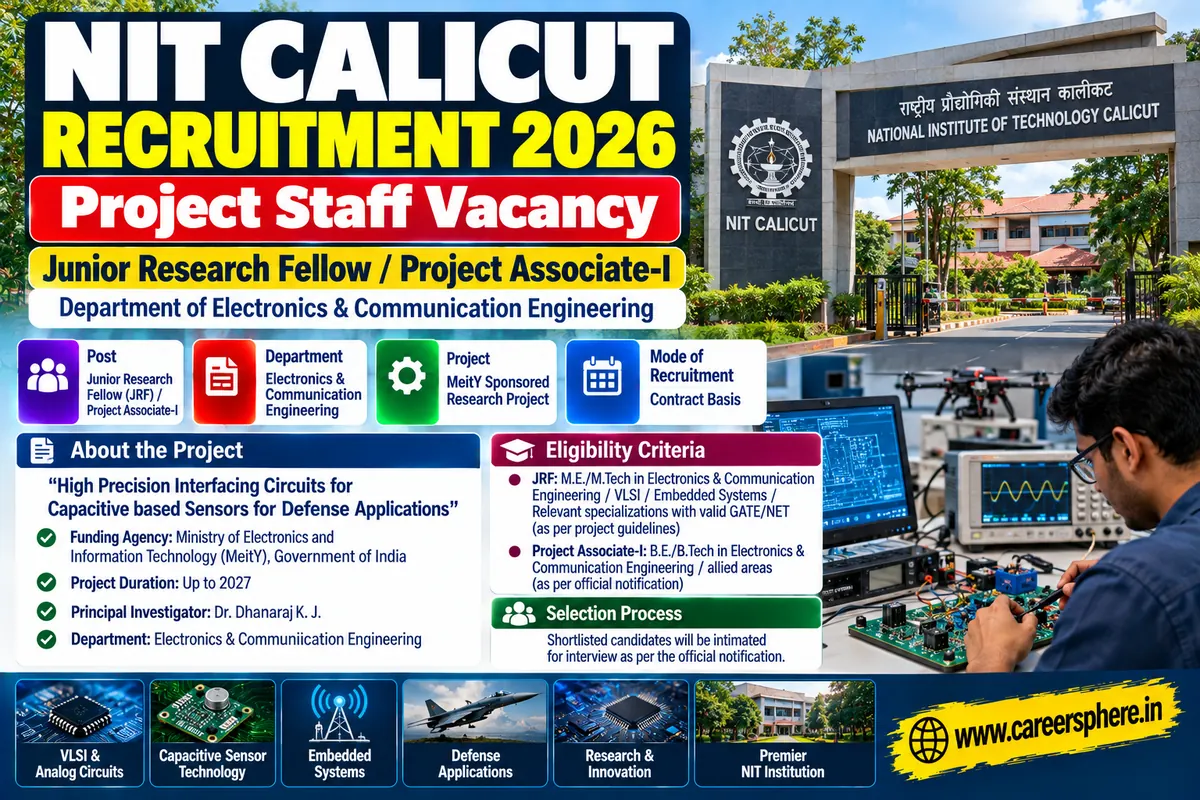
NIT Calicut Recruitment 2026: National Institute of Technology Calicut (NITC) has announced a fresh project-staff opportunity for Junior Research Fellow (JRF) / Project Associate-I on a contract basis in the Department of Electronics and Communication Engineering. The recruitment is for a Ministry of Electronics and Information Technology (MeitY), Government of India research project associated with Dr. Dhanaraj K. J. Candidates interested in electronics, sensor-interface circuits, instrumentation and research careers can examine this opportunity.
This CareerSphere guide explains the verified official listing, project context, application preparation, selection expectations and the details applicants must confirm in the NIT Calicut notification. The official notification and application form remain the final authority for qualification, fellowship, age, deadline and documentary requirements.
NIT Calicut JRF / Project Associate-I Recruitment 2026 Overview
| Institute | National Institute of Technology Calicut |
| Department | Electronics and Communication Engineering |
| Post | Junior Research Fellow / Project Associate-I |
| Engagement | Contract research position |
| Funding agency | MeitY, Government of India |
| Project investigator | Dr. Dhanaraj K. J. |
| Location | NIT Calicut, Kozhikode, Kerala |
| Application source | Official NITC notification and application form |
What has NIT Calicut announced?
NIT Calicut’s official Project Staff (Adhoc/Contract) recruitment page lists an advertisement for Junior Research Fellow/Project Associate-I for a MeitY, Government of India research project in Electronics and Communication Engineering. The official listing identifies Dr. Dhanaraj K. J. and provides links for the notification and application form.
This is a project appointment, not a regular permanent institute appointment. Project-funded positions are tied to sponsored research requirements, funding and project conditions. Applicants should therefore read this particular notification rather than assuming that rules from permanent NIT posts or other JRF advertisements apply.
Research project area
The associated research activity concerns high-precision interfacing circuits for capacitive-based sensors for defence applications. It is relevant to candidates interested in analog and mixed-signal electronics, sensor interfaces, instrumentation, circuit design, embedded measurement systems and related electronics research.
Work in a project of this nature may involve literature study, circuit or system design, simulation, prototype development, laboratory measurements, data analysis, technical documentation and project reporting. These are broad research-context examples; candidates should rely on the official advertisement and project investigator for actual assigned duties.
Who should consider applying?
The opportunity is relevant to candidates whose academic background and technical skills satisfy the exact eligibility prescribed by NIT Calicut for this project. JRF and Project Associate-I requirements can differ by funding scheme. Applicants must confirm the qualifying degree, discipline, marks or CGPA, NET/GATE requirement if any, desirable experience and age condition from the specific notification.
Do not rely on eligibility copied from another NITC project advertisement. Even two advertisements with the same designation can prescribe different disciplines and research skills.
Understanding the JRF / Project Associate-I designation
The official heading uses Junior Research Fellow/Project Associate-I. Candidates should read how the notification determines the applicable category and fellowship. National-level examination qualification or funding-agency rules can affect designation and remuneration in sponsored research appointments.
For this reason, CareerSphere is not substituting a generic CSIR, DST or MeitY fellowship figure for the amount in this specific notice. Check the notification for exact monthly fellowship, HRA treatment, tenure and extension conditions.
Contract nature and tenure
NITC categorises the opening under Project Staff (Adhoc/Contract), and the recruitment heading states that the position is on a contract basis. Selection therefore does not create a claim to a regular NIT Calicut post. Continuation can depend on project duration, funding, performance and the institute’s stated conditions.
Candidates already employed should check whether a No Objection Certificate, relieving document or employer permission is required at interview or joining.
How to apply
- Visit the official NIT Calicut Project Staff recruitment page.
- Locate the JRF/Project Associate-I advertisement for the MeitY ECE project associated with Dr. Dhanaraj K. J.
- Open the official notification and verify eligibility, remuneration, tenure, deadline and selection instructions.
- Open the application form supplied by NITC.
- Enter academic and contact details exactly as supported by certificates.
- Prepare all required certificates, mark sheets and research/experience documents.
- Submit through the mode prescribed by NIT Calicut before the official deadline.
- Retain an acknowledgement or copy of the application wherever available.
Documents to prepare
Candidates can keep degree certificates, semester or consolidated mark sheets, date-of-birth proof, photo identification, updated CV, experience certificates and national-level examination scorecard ready where applicable. Research applicants can also organise details of projects, publications, dissertations, internships, hardware/software skills and laboratory experience.
This is a preparation checklist rather than the institute’s mandatory document list. Submit only the items and format requested in the official advertisement.
Technical preparation
Because the project concerns precision interfacing circuits and capacitive sensors, candidates can revise concepts relevant to their qualifying discipline, potentially including electronic circuits, analog electronics, sensors and transducers, instrumentation, signal conditioning, noise, data acquisition, embedded systems and circuit simulation.
If you have previous project experience, be prepared to explain what you personally designed, implemented, simulated or measured. A clear account of a dissertation or final-year project is more informative than a long list of software names. Document PCB design, circuit simulation, microcontroller, laboratory instrument or sensor-system experience accurately where relevant.
Selection process
The exact shortlisting and selection method must be checked in the current notification. Sponsored project recruitment commonly involves application scrutiny and an assessment/interview for shortlisted candidates, but applicants should not assume an interview mode unless NITC states it.
Keep the email address and mobile number used in the application active and monitor the official recruitment page for updates. If called for assessment, keep documents ready in the format requested by the institute.
Important dates
This is a newly listed opportunity on NIT Calicut’s project-staff page. Candidates should use the deadline printed in the official notification/application form as the controlling date. CareerSphere is not guessing a closing date where the accessible recruitment index does not expose it clearly. Apply early after confirming eligibility.
Salary / fellowship
The applicable fellowship or remuneration should be taken directly from the specific NITC notification. Do not assume the pay from another JRF or Project Associate advertisement. Funding rules and qualification conditions can affect the amount.
Why the project is relevant
The role sits at the intersection of electronics research and sensor-interface development. Capacitive sensing is used in many measurement and control systems, while high-precision interface electronics introduces challenges involving sensitivity, noise, stability and reliable signal conversion.
For candidates planning a research career, sponsored project work may provide exposure to structured research objectives, laboratory development, technical reporting and experimental validation. Applicants should nevertheless assess the actual project duties and their own career plans rather than treating a temporary project appointment as an automatic route to a PhD or permanent employment.
Application mistakes to avoid
Do not use an old NITC application form from another project. Do not assume eligibility or fellowship is identical across project advertisements. Avoid entering a degree title, percentage or experience claim that differs from your certificates. Where a national-level examination qualification is relevant, provide accurate scorecard information. Most importantly, submit in the prescribed mode within the official deadline.
Official links
Project Staff Recruitment Page: NIT Calicut Official Recruitment Page
Specific JRF / Project Associate-I Page: Official Notification and Application Form
More research recruitment updates
Also read IIT Kanpur Chemistry Recruitment 2026 and IIT Palakkad Research Staff Recruitment 2026.
Frequently Asked Questions
What is the post?
The official listing is for Junior Research Fellow / Project Associate-I on a contract basis.
Which department is recruiting?
Department of Electronics and Communication Engineering, NIT Calicut.
Which agency supports the project?
The official heading identifies it as a MeitY, Government of India research project.
Who is the project investigator?
The listing names Dr. Dhanaraj K. J.
Is this permanent?
No. It is listed as a contract project-staff position.
Where is the application form?
NIT Calicut provides it on the specific recruitment page linked above.
What is the salary?
Check the project-specific notification for the applicable fellowship/remuneration; do not use a generic JRF rate.
What is the last date?
Use the deadline stated in the current official notification/application form and apply early.
Final note
NIT Calicut JRF / Project Associate-I Recruitment 2026 is a specialised contract research opportunity in Electronics and Communication Engineering under a MeitY-supported project. Candidates with a relevant profile should read the official advertisement, confirm every eligibility condition and submit the prescribed application within NITC’s deadline. The official notification takes precedence if any information is revised.
How to strengthen your application
For a specialised electronics research opening, a focused CV can help reviewers quickly understand the relevance of your background. Put your qualifying degree, dissertation or major project and the most relevant technical skills near the beginning. Where applicable, briefly identify hands-on experience with analog circuits, sensor interfaces, simulation, embedded platforms, PCB development, data acquisition or laboratory measurement. Candidates should describe only skills they can substantiate and should avoid copying generic keywords merely because they appear related to the project.
If the application permits a research statement or additional information, explain the connection between your previous academic work and the proposed sensor-interface research in clear language. Mention concrete outcomes such as a prototype built, circuit simulated, experiment performed, paper presented or technical problem solved. Applicants with NET, GATE or another relevant national-level qualification should enter those details exactly as shown on the valid scorecard when the notification asks for them.
Before final submission
Recheck your email address, mobile number, degree details, marks, uploaded files and file readability. Confirm that the application belongs to Dr. Dhanaraj K. J.’s MeitY project rather than another NIT Calicut project vacancy. Save the official advertisement locally for reference, note the deadline stated there, and avoid last-minute submission where possible. Any later corrigendum or recruitment update published by NIT Calicut should be treated as authoritative.
Leave a Reply