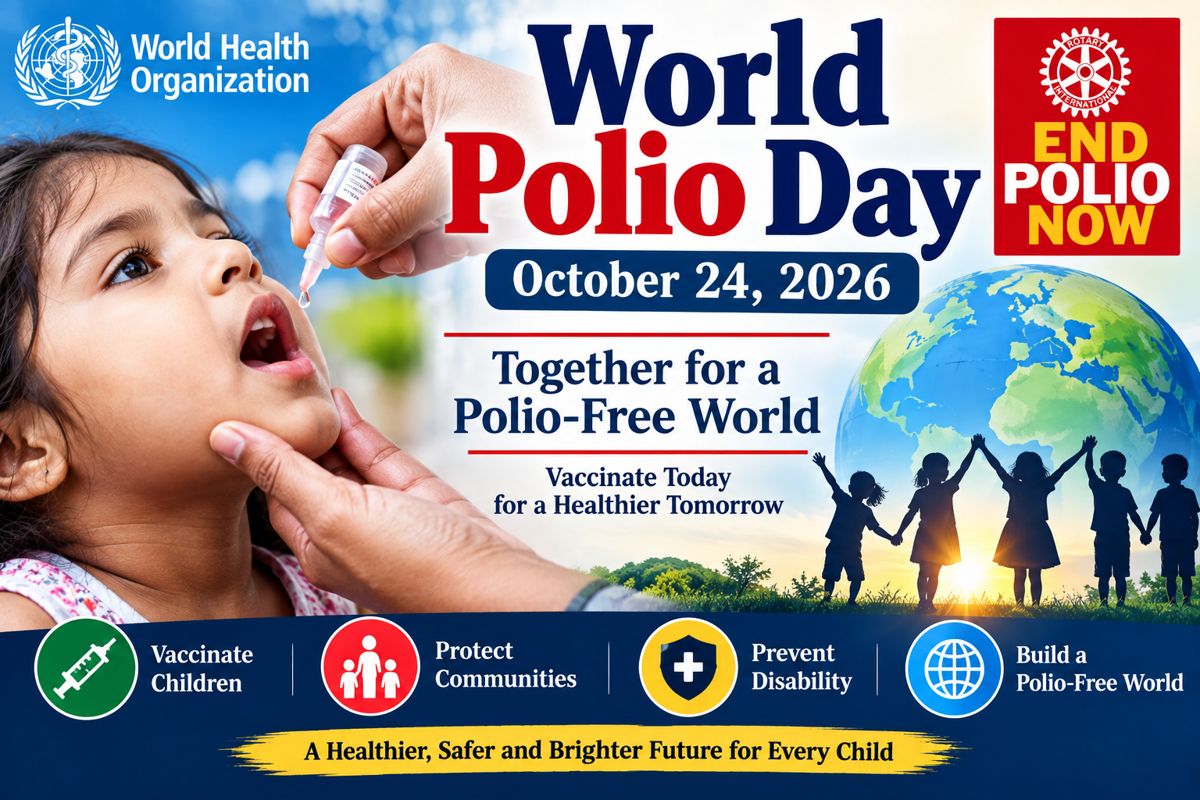
World Polio Day 2026 will be observed on Saturday, October 24, 2026. The annual observance highlights the global effort to eradicate poliomyelitis (polio), the importance of vaccination and the work of health workers, governments and communities protecting children from this preventable disease.
World Polio Day 2026: Quick Facts
| Date | October 24, 2026 |
| Day | Saturday |
| Observed worldwide | Every October 24 |
| Main focus | Polio eradication and vaccination awareness |
| Disease | Poliomyelitis (polio) |
| Prevention | Polio vaccination |
What Is World Polio Day?
World Polio Day is an annual awareness observance associated with the international campaign to end polio. It is marked on October 24 and is widely used by public-health organisations and partners to explain progress toward eradication, remaining challenges and the continuing importance of immunisation.
What Is Polio?
Poliomyelitis is a highly infectious viral disease. According to the World Health Organization, it mainly affects children under five years of age. The virus is transmitted from person to person, principally through the faecal-oral route, and multiplies in the intestine.
Most infections do not produce paralysis, but in a small proportion of cases the virus can invade the nervous system and cause irreversible paralysis. WHO notes that there is no cure for polio, but it can be prevented through vaccination.
Why Vaccination Is Essential
Polio vaccination protects children and is the central tool used in eradication programmes. Multiple doses may be needed to provide effective protection, depending on the vaccine and immunisation programme. Public-health authorities therefore emphasise completing recommended vaccination schedules and participating in supplementary immunisation campaigns where advised.
Parents should follow the vaccination schedule recommended by their national or local health authority and consult a qualified healthcare professional if they have questions about a child’s immunisation history.
The Global Polio Eradication Effort
The Global Polio Eradication Initiative was launched in 1988. It brought together national governments and international partners to interrupt poliovirus transmission worldwide. Since then, global polio cases have fallen dramatically compared with the levels seen when the initiative began.
Eradication remains a demanding public-health goal because transmission must be stopped everywhere. Surveillance, laboratory testing, vaccination campaigns, rapid outbreak response and community engagement all play important roles.
India and Polio Eradication
India’s progress against polio is a major public-health achievement. The country reported its last case of wild poliovirus in January 2011. In 2014, the WHO South-East Asia Region, including India, was certified polio-free after meeting the required criteria for interruption of indigenous wild poliovirus transmission.
Maintaining this status requires continued immunisation and surveillance because poliovirus transmission elsewhere can still create risks of importation. This is why routine vaccination and public-health monitoring remain important even in places where wild poliovirus has been eliminated.
Pulse Polio in India
India’s Pulse Polio programme became one of the country’s most visible mass-immunisation campaigns. Large numbers of vaccination teams worked through booths, homes, transit points and mobile teams to reach children. The programme demonstrated how vaccination, surveillance, logistics and community participation can combine in a large public-health campaign.
Why World Polio Day Still Matters
World Polio Day reminds communities that eradication is not the same as controlling a disease temporarily. Until transmission is interrupted globally, countries need strong immunisation systems and surveillance. The day also recognises vaccinators and health workers who often work in difficult conditions to reach every child.
World Polio Day 2026 Messages
- On World Polio Day 2026, support vaccination and the goal of a polio-free world.
- Every child deserves protection from vaccine-preventable diseases.
- October 24: raising awareness for global polio eradication.
- Thank you to vaccinators and health workers working to protect children from polio.
- A polio-free future depends on sustained immunisation, surveillance and community participation.
- Vaccination protects children and strengthens communities.
- World Polio Day reminds us that the final steps toward eradication matter.
- Stay informed and follow official immunisation guidance for your family.
WhatsApp Status Lines
- World Polio Day 2026 | October 24
- Vaccinate. Protect. End Polio.
- Together for a polio-free world.
- Every child protected is a step toward eradication.
- Support immunisation. Support a healthier future.
- October 24 | World Polio Day
Instagram and Facebook Captions
Caption 1: World Polio Day 2026 reminds us that vaccination, surveillance and community participation remain essential to the global goal of ending polio.
Caption 2: October 24 is World Polio Day. Recognising health workers and vaccinators who continue working toward a world free from polio.
Caption 3: India has remained free of indigenous wild poliovirus transmission since its last reported case in 2011, but continued immunisation and surveillance remain important.
Short Speech for World Polio Day 2026
Good morning everyone. Today, October 24, we observe World Polio Day. Polio is a highly infectious viral disease that can cause irreversible paralysis, particularly in children. There is no cure, but vaccination can prevent the disease. The global eradication effort launched in 1988 has reduced polio enormously, and India’s last case of wild poliovirus was reported in 2011. This progress was possible because of vaccination, disease surveillance, health workers and community participation. However, the global goal is not complete until transmission is stopped everywhere. On World Polio Day, let us support evidence-based vaccination programmes and recognise those working to protect every child. Thank you.
School and College Activity Ideas
- Create an infographic explaining how vaccines prevent infectious diseases.
- Prepare a timeline of the global polio eradication campaign.
- Study India’s Pulse Polio programme as a public-health case study.
- Organise a quiz on vaccines and communicable diseases.
- Invite a healthcare professional to discuss immunisation and disease prevention.
- Create posters thanking frontline vaccination workers.
- Discuss how misinformation can affect public-health programmes and why reliable sources matter.
Frequently Asked Questions
When is World Polio Day 2026?
World Polio Day 2026 falls on Saturday, October 24.
What causes polio?
Polio is caused by poliovirus, an infectious virus that can invade the nervous system in a small proportion of cases.
Can polio be prevented?
Yes. Polio can be prevented through vaccination. Follow the immunisation guidance of qualified health authorities.
Is there a cure for polio?
WHO states that there is no cure for polio, but the disease is preventable with vaccination.
When was India’s last wild polio case?
India’s last reported case of wild poliovirus occurred in January 2011.
When was India certified polio-free?
India was part of the WHO South-East Asia Region certified polio-free in 2014.
Why is vaccination still important in polio-free countries?
Until poliovirus transmission is stopped globally, importation and outbreaks remain possible. Maintaining high immunisation coverage and surveillance reduces that risk.
Explore More October 2026 Important Days
Visit CareerSphere News for more important October observances. You can also read our ITBP Raising Day 2026 and Police Commemoration Day 2026 articles.
Health Information Note
This article is for general educational awareness and is not individual medical advice. For questions about vaccination, symptoms or a child’s immunisation schedule, consult a qualified healthcare professional or your local public-health authority.
Final Note
World Polio Day 2026 is an opportunity to recognise extraordinary progress while remembering that global eradication requires continued vaccination, surveillance and cooperation. Reliable information from WHO and national health authorities should guide decisions about immunisation and disease prevention.
Leave a Reply