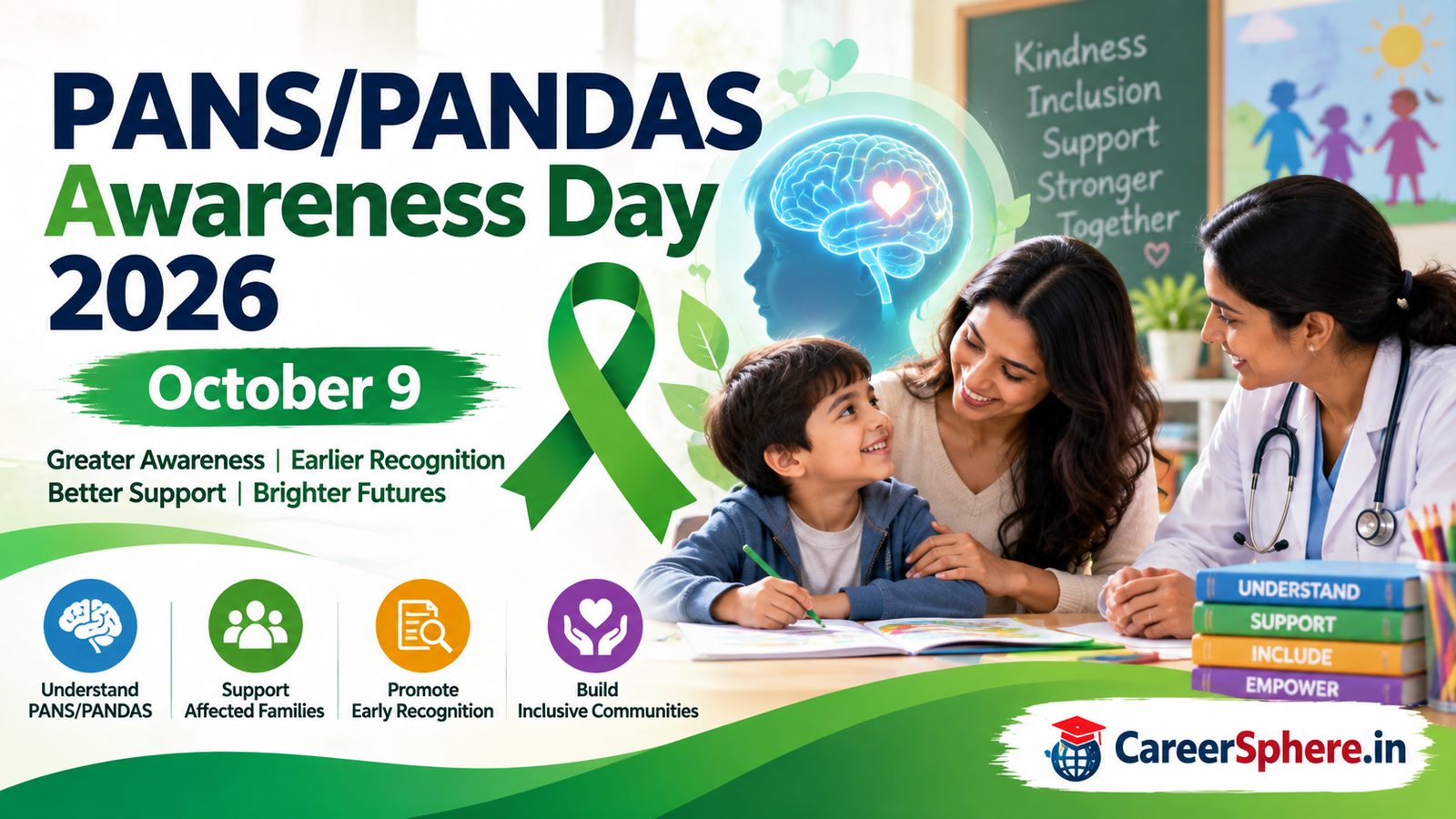
PANS/PANDAS Awareness Day 2026: October 9, Symptoms, Meaning & Awareness
PANS/PANDAS Awareness Day 2026 will be observed on Friday, October 9, 2026. The annual observance aims to improve understanding of two uncommon and often misunderstood neuropsychiatric conditions: Pediatric Acute-onset Neuropsychiatric Syndrome (PANS) and Pediatric Autoimmune Neuropsychiatric Disorders Associated with Streptococcal Infections (PANDAS).
Awareness organisations use October 9 to bring families, clinicians, educators and supporters together around recognition, research, appropriate evaluation and support. The PANDAS Physicians Network identifies October 9 as PANS/PANDAS Awareness Day and says the day is intended to increase awareness of treatable immune-mediated neuropsychiatric conditions.
PANS/PANDAS Awareness Day 2026: Quick Facts
| Observance | PANS/PANDAS Awareness Day |
|---|---|
| Date | October 9, 2026 |
| Day | Friday |
| Main focus | Awareness, education, research and support |
| Conditions | PANS and PANDAS |
| Audience | Families, healthcare professionals, educators and the public |
What Are PANS and PANDAS?
PANS stands for Pediatric Acute-onset Neuropsychiatric Syndrome. The PANDAS Physicians Network describes it as a clinical syndrome involving the sudden onset of obsessive-compulsive symptoms and/or restrictive eating accompanied by other acute neuropsychiatric symptoms.
PANDAS stands for Pediatric Autoimmune Neuropsychiatric Disorders Associated with Streptococcal Infections. It refers to a subset associated with Group A Streptococcus and specific clinical criteria.
These terms describe clinical conditions that require professional evaluation. An awareness article cannot determine whether a particular child has PANS, PANDAS or another medical condition.
When Is PANS/PANDAS Awareness Day 2026?
PANS/PANDAS Awareness Day 2026 is on October 9, 2026. PANDAS Network states that it recognises PANDAS/PANS Awareness Day each year on October 9, while PANS PANDAS UK describes October 9, 2026 as a global awareness event.
Why Is PANS/PANDAS Awareness Day Important?
1. Recognising abrupt changes
PANS/PANDAS can involve a sudden change in behaviour, eating, emotional regulation, movement or other neuropsychiatric functions. Awareness helps families understand that an abrupt change deserves appropriate professional attention.
2. Supporting families
Families may face uncertainty when symptoms appear suddenly. Awareness activities create opportunities to find reliable information and connect with other families and professionals.
3. Improving professional education
Awareness organisations emphasise education for clinicians and multidisciplinary collaboration. PPN provides clinical resources, diagnostic flowcharts and research information for professionals.
4. Encouraging research
Research is an important part of improving understanding, diagnosis and management. PPN highlights ongoing research and collaboration with universities and clinical researchers.
Commonly Described Signs and Symptoms
The PANDAS Physicians Network states that PANS/PANDAS can involve an abrupt onset of obsessive-compulsive symptoms, restrictive eating and other neuropsychiatric changes. Associated features can include anxiety, emotional or behavioural changes, sensory or motor abnormalities, sleep problems, urinary symptoms and changes in school performance.
| Area | Examples described by PPN |
|---|---|
| Behaviour | Behavioural regression, irritability or sudden behavioural change |
| Emotional health | Anxiety, separation anxiety and mood changes |
| Obsessive-compulsive symptoms | Sudden onset or recurrence of OCD symptoms |
| Eating | Sudden restrictive eating |
| Motor/sensory function | Tics, motor abnormalities or sensory amplification |
| School functioning | Sudden deterioration in school performance or handwriting |
| Other physical/neurological features | Urinary symptoms and sleep disturbances |
These symptoms are not specific to PANS/PANDAS. Similar symptoms can occur with other conditions, which is why professional assessment is important.
PANS and PANDAS: What Is the Difference?
| Feature | PANS | PANDAS |
|---|---|---|
| Name | Pediatric Acute-onset Neuropsychiatric Syndrome | Pediatric Autoimmune Neuropsychiatric Disorders Associated with Streptococcal Infections |
| Core presentation | Acute onset of OCD and/or restrictive eating with additional symptoms | Acute onset of OCD and/or tics with additional clinical features |
| Infection relationship | Not limited to streptococcal infection | Associated with Group A Streptococcus |
| Diagnosis | Clinical evaluation using established criteria | Clinical evaluation using established criteria including the relevant infection relationship |
PPN notes that PANS does not require a streptococcal infection, whereas PANDAS is defined as a subset associated with Group A Streptococcus.
What Causes PANS/PANDAS?
The biology of PANS/PANDAS is an area of ongoing medical research. PPN describes these conditions in terms of immune-mediated neuroinflammation and notes that PANS can be associated with different infections, while PANDAS has a specific association with Group A Streptococcus.
It is important not to interpret an infection followed by a behavioural or psychiatric change as proof of PANS or PANDAS. Diagnosis requires appropriate clinical evaluation and consideration of other possible explanations.
Diagnosis and Professional Evaluation
PANS/PANDAS diagnosis is clinical and can be complex. PPN provides diagnostic flowcharts and consensus-based resources for clinicians. Its published PANS criteria include abrupt onset or abrupt recurrence of OCD or restrictive eating, at least two additional acute neuropsychiatric symptoms, and the requirement that symptoms are not better explained by another known neurological or medical disorder.
Why professional evaluation matters
- Several medical and psychological conditions can produce overlapping symptoms.
- A sudden change in a child’s behaviour or functioning can have multiple possible causes.
- Clinical history and examination are important.
- Healthcare professionals can decide which investigations are appropriate.
- Families should avoid self-diagnosis based only on online symptom lists.
How PANS/PANDAS Can Affect School Life
Sudden neuropsychiatric and behavioural changes can affect attendance, concentration, handwriting, eating routines, peer relationships and academic performance. PANS PANDAS UK’s 2026 awareness programme includes a school initiative called Go Green with Glitch, designed to promote awareness and inclusion for children and young people affected by PANS and PANDAS.
Schools can respond constructively by listening to families, communicating with appropriate professionals and following their own safeguarding, attendance and support procedures. Individual accommodations should be based on the child’s circumstances rather than assumptions.
How Families Can Support a Child
- Record sudden changes in symptoms, behaviour or daily functioning to discuss with a healthcare professional.
- Keep communication calm and supportive.
- Maintain appropriate school communication when symptoms affect attendance or learning.
- Use reliable medical and patient-support resources rather than social-media claims.
- Protect the child’s privacy when sharing information online.
- Seek professional help when symptoms are sudden, severe or concerning.
How Teachers and Schools Can Help
Listen and communicate
Teachers may notice changes in concentration, handwriting, behaviour or participation. Sharing observations through appropriate school channels can help families and professionals build a clearer picture.
Provide reasonable flexibility
Where appropriate, schools may consider individual support arrangements under their existing policies. The right approach depends on the child’s needs and the school’s applicable procedures.
Promote inclusion
Awareness should not become labelling. Children experiencing health-related difficulties should be treated with dignity and included in school life as far as reasonably possible.
PANS/PANDAS Awareness Day 2026 Activities
Awareness activities can be educational, community-based or online. PANDAS Network encourages people to learn about the conditions, support awareness activities and explore resources for communities.
- Share verified information about PANS/PANDAS.
- Talk about the importance of appropriate evaluation.
- Support awareness campaigns.
- Participate in school or community awareness activities.
- Learn about current research.
- Support families affected by the conditions.
PANS/PANDAS Awareness Day 2026 in the UK
PANS PANDAS UK has announced a three-day Perspectives on PANS conference running from October 8 to October 10, 2026. Its 2026 awareness programme also includes a school-focused Go Green with Glitch initiative and research and professional education activities.
Practical Awareness Checklist
- Know the terms: Understand what PANS and PANDAS stand for.
- Recognise abrupt change: Sudden and dramatic changes in behaviour, eating or neuropsychiatric symptoms should not simply be dismissed.
- Seek appropriate help: Discuss concerning symptoms with a qualified healthcare professional.
- Support school communication: Share relevant observations through appropriate channels.
- Use reliable sources: Prefer medical organisations, professional guidance and established patient organisations.
- Protect privacy: Do not publicly share a child’s medical details without appropriate consent.
What Not to Do
- Do not diagnose PANS or PANDAS from a social-media checklist.
- Do not assume that every sudden behavioural change is caused by an infection.
- Do not stop or start medical treatment without professional advice.
- Do not present disputed or emerging research as settled medical fact.
- Do not stigmatise children because of sudden changes in behaviour or school performance.
Research and the Future
Research remains important because scientists and clinicians continue to study the biological mechanisms, diagnostic approaches and management of PANS/PANDAS. PPN maintains research and clinical-literature resources and reports collaborations with academic institutions.
For families, this means awareness should be connected to evidence-based information rather than sensational claims. New research may change understanding over time, so medical guidance should be interpreted in the context of current professional evidence.
Frequently Asked Questions
When is PANS/PANDAS Awareness Day 2026?
PANS/PANDAS Awareness Day 2026 is on October 9, 2026.
What does PANS stand for?
PANS stands for Pediatric Acute-onset Neuropsychiatric Syndrome.
What does PANDAS stand for?
PANDAS stands for Pediatric Autoimmune Neuropsychiatric Disorders Associated with Streptococcal Infections.
Are PANS and PANDAS the same condition?
No. They are related clinical concepts, but PANDAS is a specific subset associated with Group A Streptococcus, while PANS has broader criteria and does not require a streptococcal infection.
What are common symptoms discussed in PANS/PANDAS awareness?
Awareness resources describe abrupt OCD symptoms or restrictive eating together with other possible neuropsychiatric, behavioural, sensory, motor, urinary, sleep or school-function changes. These features can have other causes and require professional evaluation.
Can an online article diagnose PANS or PANDAS?
No. Diagnosis requires appropriate clinical evaluation by qualified healthcare professionals.
How can people observe Awareness Day?
People can learn from reliable sources, share accurate information, support affected families, participate in appropriate community or school activities and help promote research and professional education.
Important Medical Disclaimer
This article is for general awareness and educational purposes. It does not diagnose PANS, PANDAS or any other condition, and it does not replace advice from a qualified healthcare professional. If a child develops sudden, severe or concerning symptoms, parents or caregivers should seek appropriate medical evaluation.
Key Points to Remember
- PANS/PANDAS Awareness Day is observed on October 9.
- In 2026, the date falls on Friday, October 9.
- PANS refers to Pediatric Acute-onset Neuropsychiatric Syndrome.
- PANDAS refers to Pediatric Autoimmune Neuropsychiatric Disorders Associated with Streptococcal Infections.
- PANS does not require a streptococcal infection, while PANDAS has a specific association with Group A Streptococcus.
- Sudden OCD symptoms or restrictive eating can be important clinical features within PANS criteria.
- Other neuropsychiatric, behavioural, sensory, motor, urinary, sleep and school-function changes may also occur.
- Diagnosis requires professional clinical evaluation.
- Awareness Day promotes education, support and research.
One-Day Awareness Planner for October 9
| Time | Suggested activity | Purpose |
|---|---|---|
| Morning | Read one reliable PANS/PANDAS overview | Build accurate basic understanding |
| Midday | Share one short, verified awareness message | Improve public awareness |
| Afternoon | Discuss respectful school or family support | Promote inclusion |
| Evening | Review reputable research or professional resources | Encourage evidence-based learning |
This planner is an awareness framework, not a medical care plan. People should adapt activities to their setting and avoid presenting awareness materials as diagnosis or treatment advice.
Conclusion
PANS/PANDAS Awareness Day 2026 on October 9 provides an opportunity to learn about conditions associated with abrupt neuropsychiatric and behavioural changes in children and young people. The most useful form of awareness combines accurate information, appropriate professional evaluation, support for families, inclusive school practices and continued research. By focusing on evidence and compassion, communities can help reduce misunderstanding while respecting the complexity of these conditions.
Leave a Reply