World Science Day 2026: November 10, Theme, History & Science Diplomacy
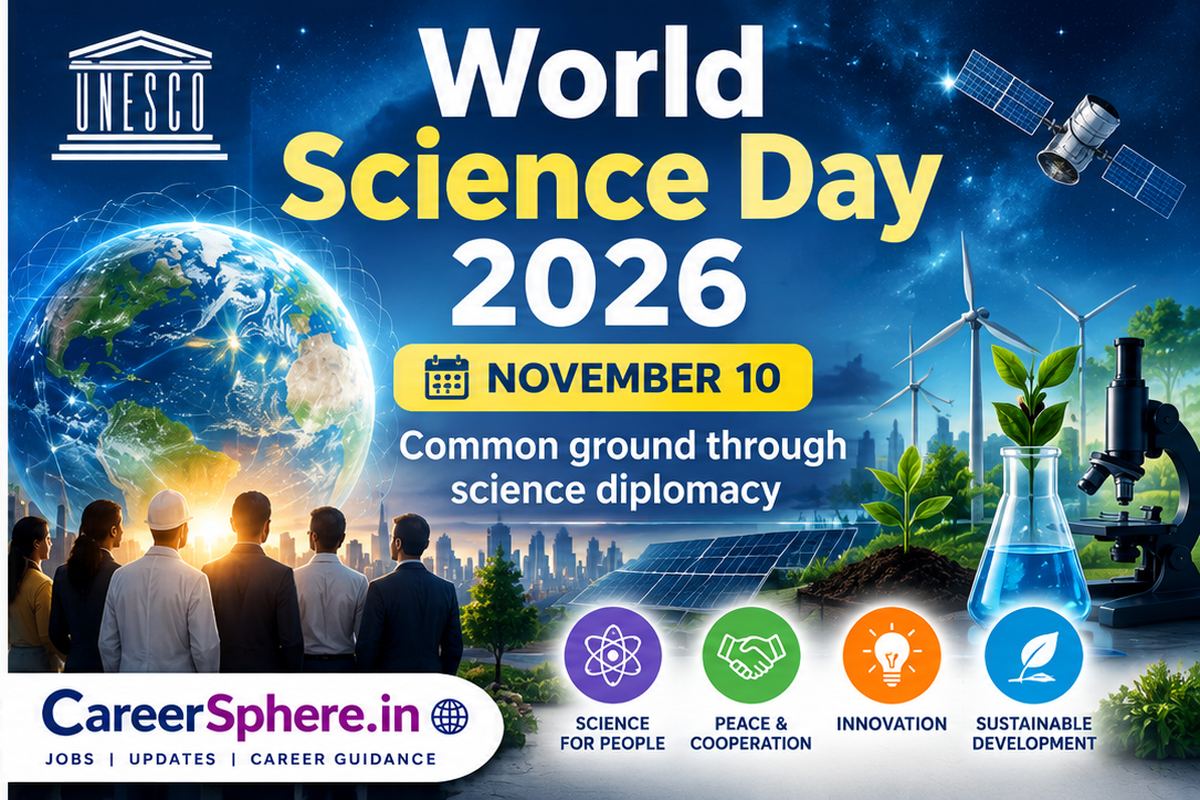
World Science Day for Peace and Development 2026 will be observed on November 10, 2026. The annual UNESCO observance highlights the role of science in society, encourages public engagement with scientific issues and promotes international cooperation. The 2026 theme is “Common ground through science diplomacy.”
World Science Day 2026: Key Details
| Detail | Information |
|---|---|
| Observance | World Science Day for Peace and Development |
| Date | November 10, 2026 |
| Day | Tuesday |
| 2026 Theme | Common ground through science diplomacy |
| Established | UNESCO proclaimed the observance in 2001 |
| Main focus | Science, peace, development, public awareness and cooperation |
| Participants | Students, teachers, researchers, institutions and the public |
What Is World Science Day for Peace and Development?
World Science Day for Peace and Development is observed every November 10 to highlight the importance of science in society. UNESCO says the day is intended to strengthen public awareness of science and its role in peaceful and sustainable societies. It also provides an opportunity to engage the wider public in discussions about scientific issues.
Science is connected to everyday life through healthcare, agriculture, communications, transport, energy, climate research, engineering and digital technologies. World Science Day creates a space to discuss these connections and the responsibilities that accompany scientific progress.
World Science Day 2026 Date and Day
World Science Day for Peace and Development 2026 falls on Tuesday, November 10, 2026. November 10 is the annual date of the observance. UNESCO’s current 2026 information lists the theme as “Common ground through science diplomacy.”
World Science Day 2026 Theme
The theme of World Science Day 2026 is “Common ground through science diplomacy.” The theme draws attention to how scientific cooperation and dialogue can create opportunities for shared understanding across borders.
Science diplomacy can bring together scientists, universities, governments, international organizations and other stakeholders around issues that benefit from shared evidence and expertise. Climate research, public health, disaster preparedness, water, food systems, space science and emerging technologies are examples of areas where international cooperation can be valuable.
What Does “Common Ground” Mean?
In this context, common ground means areas where institutions and communities can cooperate despite differences in geography, culture, priorities or national interests. Scientific evidence, research networks, shared methods and professional relationships can provide a practical basis for dialogue.
Science does not remove every disagreement, and scientific findings still require careful testing and evaluation. However, cooperation can create channels for exchanging information, comparing evidence, developing standards and working on problems that cross national boundaries.
History of World Science Day
UNESCO proclaimed World Science Day for Peace and Development in 2001. The observance developed from the goal of strengthening links between science and society and encouraging public discussion about science.
Since then, November 10 has provided an annual opportunity for schools, universities, research organizations, governments and science communicators to organize programmes and explain how scientific knowledge contributes to society.
Why Is World Science Day Important?
- Promotes scientific awareness: It encourages people to understand how science affects everyday life.
- Supports cooperation: It highlights the value of researchers and institutions working together across borders.
- Encourages students: Schools and colleges can use the day to inspire interest in STEM subjects.
- Connects science and society: It creates opportunities for dialogue among scientists, educators, media and the public.
- Supports sustainable development: Research can contribute to better health, energy, agriculture, water management and environmental protection.
- Encourages informed discussion: Public understanding helps people engage more thoughtfully with emerging technologies and scientific evidence.
Science and Peace: How Are They Connected?
Scientific collaboration can bring researchers and institutions from different countries together around shared objectives. Research partnerships can involve laboratories, universities and experts exchanging data, methods and technical knowledge.
International scientific projects can also create long-term professional relationships. Fields such as climate observation, ocean science, disease surveillance, space research and disaster-risk reduction often benefit from information collected across geographic boundaries.
Science cannot by itself resolve every political or social disagreement. Its contribution can instead be practical: shared evidence and professional dialogue may help create common ground for addressing challenges that affect several countries or communities.
Role of Students in World Science Day 2026
Students are central to science education and future innovation. Schools and colleges can use November 10 to make science more practical by connecting classroom concepts with real-world questions.
| Activity | What Students Can Do |
|---|---|
| Science exhibition | Present models, experiments and research projects. |
| Science quiz | Test knowledge of physics, chemistry, biology, space and technology. |
| Research presentation | Explain a discovery or investigate a local environmental issue. |
| Debate | Discuss responsible use of emerging technologies and scientific evidence. |
| Science communication | Create posters, articles, videos or presentations in simple language. |
| Innovation challenge | Develop ideas related to water, waste, energy, accessibility or public health. |
World Science Day Activities for Schools and Colleges
Educational institutions can organize programmes that connect science with real problems. A science communication activity can ask students to explain a complex scientific topic so that a general audience can understand it.
Schools and colleges can also invite researchers, engineers, doctors, environmental experts or science communicators for interactive sessions. Students can prepare questions beforehand and learn how research is conducted, evaluated and communicated.
Simple World Science Day Programme Ideas
- Introduce the 2026 theme and explain science diplomacy.
- Conduct a science quiz for different age groups.
- Organize a project or model exhibition.
- Invite a scientist, engineer or researcher for an interaction.
- Hold a poster, essay or speech competition.
- Ask students to identify a local problem that science can help address.
- Show an educational science documentary or demonstration.
- Publish student science articles through the institution’s website or newsletter.
Science Diplomacy and International Cooperation
Science diplomacy is relevant when scientific questions cross borders or when cooperation can help countries address common challenges. Scientists may collaborate on data collection, research infrastructure, standards, monitoring systems and knowledge exchange.
Climate and weather observations illustrate this clearly. Understanding changes in the atmosphere and oceans depends on measurements from many locations. Research into infectious diseases, biodiversity, food security and natural hazards can likewise benefit from information sharing.
The 2026 theme provides an opportunity to discuss how scientific networks can support communication and cooperation while maintaining rigorous research practices and responsible knowledge sharing.
World Science Day and Sustainable Development
Scientific research contributes to many areas of sustainable development. Innovation can support cleaner energy, efficient agriculture, better healthcare, resilient infrastructure and improved environmental monitoring.
| Area | Possible Contribution of Science |
|---|---|
| Health | Medical research, diagnostics, medicines and public-health evidence. |
| Climate | Observation, modelling, adaptation research and emissions measurement. |
| Agriculture | Crop science, soil research, water efficiency and food-system innovation. |
| Energy | Renewable technologies, storage, efficiency and grid research. |
| Water | Water-quality monitoring, conservation and treatment technologies. |
| Disaster management | Risk mapping, early-warning systems and resilient infrastructure research. |
| Digital technology | Computing, communications, cybersecurity and responsible technology development. |
World Science Day 2026 in India
In India, World Science Day can be observed by schools, colleges, universities, research organizations and science clubs. Students can explore Indian contributions to space science, agriculture, medicine, engineering, biotechnology, mathematics and information technology.
Institutions can connect the 2026 theme with research cooperation by explaining how universities, laboratories and scientific organizations exchange knowledge and participate in international projects. Science clubs can also use the day to introduce students to research careers and the importance of scientific communication.
CareerSphere readers interested in science and technology can also explore our International Astronautical Congress 2026 coverage for a related look at the global space sector.
World Science Day Messages
- “On World Science Day 2026, let science build bridges of knowledge, cooperation and peace.”
- “Science grows stronger when knowledge is shared. Celebrate World Science Day with curiosity and collaboration.”
- “Let evidence, innovation and cooperation help create a more sustainable future.”
- “Common ground through science diplomacy reminds us that shared challenges can inspire shared solutions.”
- “Encourage curiosity today and support the scientists, researchers and innovators of tomorrow.”
5 Practical Actions for World Science Day 2026
Anyone planning a World Science Day activity can follow these five practical steps:
- Select a real issue: Choose a topic such as clean energy, water, climate, public health, food security or disaster preparedness.
- Check reliable evidence: Use information from universities, scientific institutions, UNESCO and other recognised sources.
- Explain the science: Prepare a short presentation that separates established evidence from questions that still require research.
- Create a discussion: Ask participants what scientific cooperation could contribute and what information is still missing.
- Record the outcome: Finish with one concrete follow-up action, such as a student project, awareness poster, research presentation or community session.
60-Minute World Science Day 2026 Programme
Schools, colleges and workplaces can use this ready-to-follow format for a one-hour programme:
| Time | Activity | Action |
|---|---|---|
| 0–10 min | Theme introduction | Explain the 2026 theme and why science diplomacy matters. |
| 10–25 min | Science presentation | Present one scientific issue and explain the evidence in simple language. |
| 25–40 min | Group discussion | Ask participants to identify a shared challenge and possible scientific responses. |
| 40–50 min | Quiz or demonstration | Use a short science quiz or safe classroom demonstration. |
| 50–60 min | Action pledge | Record one practical science-learning or outreach action for the coming month. |
How to Celebrate World Science Day 2026
Use this simple checklist to turn the observance into a practical learning activity:
- Choose one science topic connected with a local or global challenge.
- Use reliable scientific or institutional sources before preparing educational material.
- Invite students or colleagues to discuss evidence, possible solutions and unanswered questions.
- Record the activity through a short report, poster, presentation or school newsletter.
- Share verified science information rather than unverified claims or sensational headlines.
Celebration does not require a large event. Individuals can read about a scientific topic, visit a science museum, attend an educational programme, participate in a science competition or discuss a scientific issue with classmates and colleagues.
Schools and organizations can choose one practical topic such as water use, waste management, energy consumption or local biodiversity. Participants can study the issue, review evidence and propose practical improvements. Such activities turn the observance into learning rather than a ceremonial event alone.
World Science Day 2026: FAQs
When is World Science Day 2026?
World Science Day for Peace and Development will be observed on November 10, 2026.
What is the theme of World Science Day 2026?
The 2026 theme is “Common ground through science diplomacy.”
Who established World Science Day?
UNESCO proclaimed World Science Day for Peace and Development in 2001.
Why is World Science Day celebrated?
It raises public awareness of the role of science in society and promotes scientific cooperation, peace and sustainable development.
What can students do on World Science Day?
Students can participate in science exhibitions, quizzes, project presentations, debates, poster competitions, research discussions and innovation activities.
What is science diplomacy?
Science diplomacy broadly refers to the use of scientific cooperation, evidence and scientific networks to support dialogue and collaboration among countries and communities.
Related CareerSphere Articles
- International Astronautical Congress 2026: Dates, Venue, Theme & Important Facts
- World Coding Day 2026: Date, History, Significance & Coding Facts
- World Students’ Day 2026: October 15, Dr. APJ Abdul Kalam & Key Facts
Final Takeaway
World Science Day for Peace and Development 2026 will be observed on November 10 under the theme “Common ground through science diplomacy.” The observance offers an opportunity to understand how scientific knowledge, research partnerships and public engagement can support peaceful and sustainable development. For students and educators, it is also a useful occasion to turn curiosity into projects, discussions and practical learning.
Leave a Reply