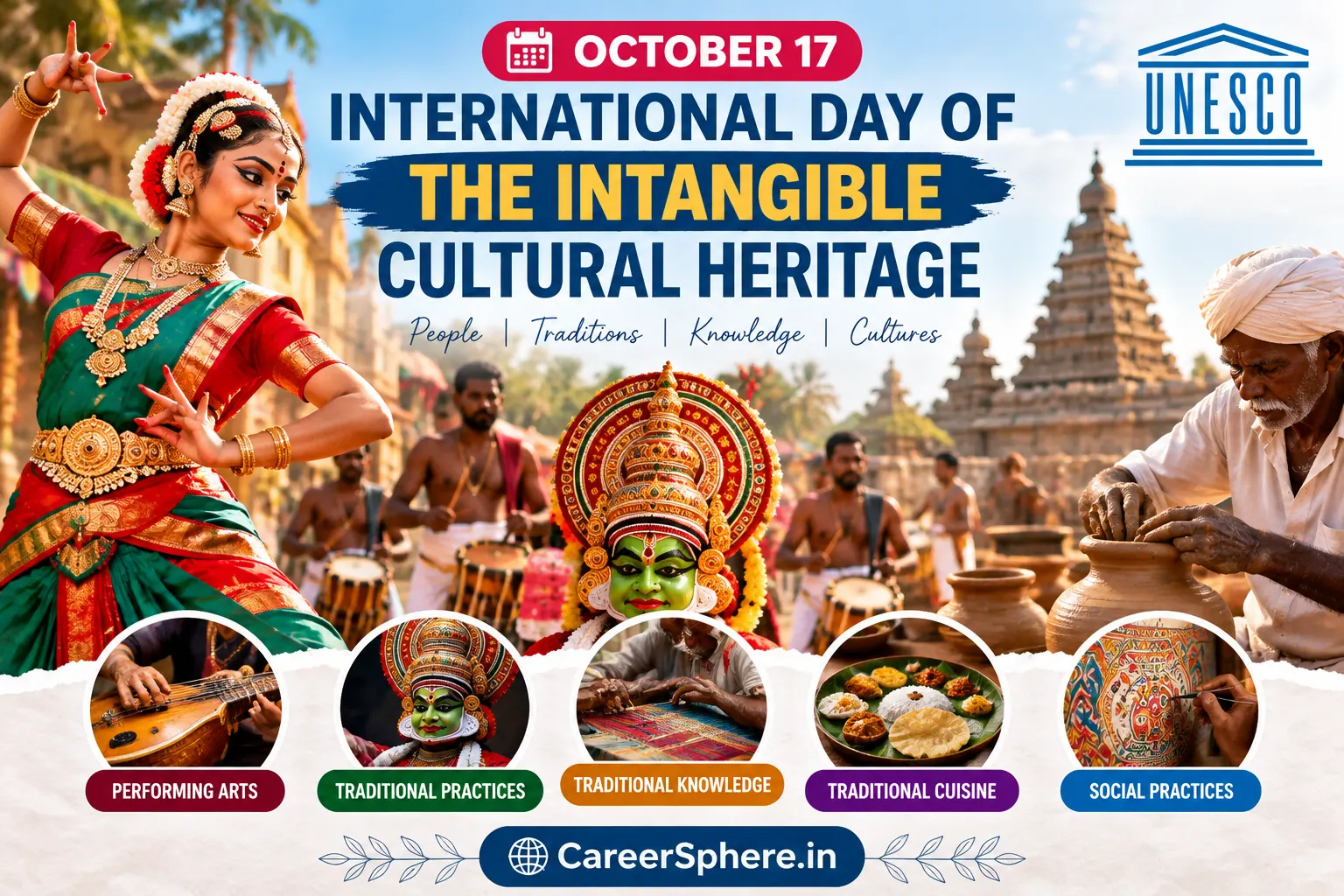
International Day of the Intangible Cultural Heritage 2026 will be observed on 17 October 2026. The UNESCO observance highlights the living traditions, knowledge, skills and cultural practices that communities pass from one generation to another. In 2026, UNESCO marks the third edition of this international day and encourages communities, cultural institutions, governments and organisations to showcase living heritage and promote its safeguarding.
International Day of the Intangible Cultural Heritage 2026: Key Facts
| Observance | International Day of the Intangible Cultural Heritage |
|---|---|
| Date | 17 October 2026 |
| Day | Saturday |
| Proclaimed by | UNESCO General Conference |
| First observed | 2024 |
| 2026 edition | Third edition |
| Main purpose | Raise awareness of living heritage and the importance of safeguarding it |
What Is Intangible Cultural Heritage?
Intangible cultural heritage is often called living heritage. Unlike monuments or museum objects, it refers to traditions and knowledge that remain alive because people continue to practise, teach and adapt them. It can include oral traditions, performing arts, social practices, rituals, festive events, knowledge concerning nature and the universe, and traditional craftsmanship.
Living heritage is not frozen in the past. Communities continually recreate it in response to their environment, history and social conditions. This makes safeguarding different from simply preserving an object: the people who practise and transmit the tradition remain central.
History of the International Day
The UNESCO General Conference proclaimed 17 October as the International Day of the Intangible Cultural Heritage at its 42nd session in November 2023. The observance complements UNESCO’s work under the 2003 Convention for the Safeguarding of the Intangible Cultural Heritage.
The first edition was celebrated in 2024. By creating a dedicated annual day, UNESCO provided communities and institutions with a recurring opportunity to explain why living traditions matter and to encourage participation in their safeguarding.
Why Is the Day Important?
Cultural heritage helps communities maintain a sense of identity and continuity. Traditional knowledge can also contribute to education, creativity, sustainable development and dialogue between generations. When practitioners disappear or younger generations no longer have opportunities to learn, valuable knowledge may be lost.
The international day therefore focuses attention on transmission. Documentation can be useful, but safeguarding also means creating conditions in which communities can continue practising their heritage and passing skills and knowledge to others.
Examples of Living Heritage
Intangible heritage can look very different across countries and communities. Examples include storytelling traditions, folk music and dance, seasonal festivals, community rituals, indigenous knowledge, traditional food practices, weaving, pottery, woodwork and other craft skills.
India has especially rich living traditions across languages, regions and communities. Classical and folk performance traditions, festivals, craft knowledge, oral traditions and community practices illustrate how cultural knowledge continues through active participation.
How to Celebrate on 17 October 2026
- Attend a local cultural performance, exhibition or craft demonstration.
- Invite elders or practitioners to share stories and traditional knowledge with students.
- Record oral histories with the informed consent of the people involved.
- Learn about a traditional craft directly from practitioners.
- Organise school or college programmes on local living heritage.
- Support artisans and community-led cultural initiatives.
- Share accurate information about local traditions while respecting community ownership and context.
Activities for Schools and Colleges
Educational institutions can conduct heritage quizzes, storytelling sessions, folk-art demonstrations, poster competitions and student presentations. A useful activity is to ask students to document one living tradition in their family or locality, including who practises it, how it is learned and how it has changed over time.
Schools can also invite craftspeople, musicians or community knowledge holders to demonstrate their skills. Such interaction helps students understand that heritage is carried by people rather than existing only in textbooks.
Role of Communities in Safeguarding Heritage
Communities are essential to safeguarding intangible cultural heritage because they are the practitioners and knowledge holders. Effective safeguarding should respect their participation and decisions about how their traditions are represented and transmitted.
Supporting apprenticeships, community festivals, local-language documentation and opportunities for younger practitioners can help traditions remain viable. Digital tools may support awareness and documentation, but they should complement rather than replace community practice.
International Day of the Intangible Cultural Heritage 2026 and UNESCO
For the 2026 observance, UNESCO encourages States Parties, cultural institutions, communities, non-governmental organisations, category 2 centres, UNESCO Chairs and other stakeholders connected with the 2003 Convention to organise activities. UNESCO also provides a dedicated platform where eligible activities can be showcased.
The observance offers an opportunity to recognise cultural diversity while emphasising that safeguarding living heritage depends on continued transmission, respect and community participation.
Frequently Asked Questions
When is International Day of the Intangible Cultural Heritage 2026?
It is observed on 17 October 2026.
Who proclaimed the International Day of the Intangible Cultural Heritage?
The day was proclaimed by UNESCO’s General Conference at its 42nd session in November 2023.
What does intangible cultural heritage mean?
It refers to living traditions, practices, expressions, knowledge and skills that communities recognise as part of their cultural heritage and transmit across generations.
Why is intangible cultural heritage called living heritage?
It is called living heritage because people continue to practise, adapt and transmit it rather than preserving it only as a physical object from the past.
How can students observe the day?
Students can participate in heritage quizzes, storytelling, traditional-art workshops, local-history projects, cultural performances and conversations with community practitioners.
Conclusion
International Day of the Intangible Cultural Heritage 2026 on 17 October is a reminder that culture lives through people. Safeguarding traditions requires more than recording them: communities need opportunities to practise, teach and adapt their knowledge. By learning from practitioners, supporting cultural transmission and respecting the communities behind each tradition, people can help living heritage continue for future generations.
Leave a Reply